Article: A Glass With… Artist and Ceramicist Jonathan Hook
A Glass With… Artist and Ceramicist Jonathan Hook
I’ve only met Jonathan twice, and he already feels like an old friend. I first came to know him through his ceramics, discovered on the shelves and tabletops of friends’ homes. His distinctive palette and forms reflect the natural beauty of Western Australia’s Great Southern, the region in which he has lived and worked for much of his life.
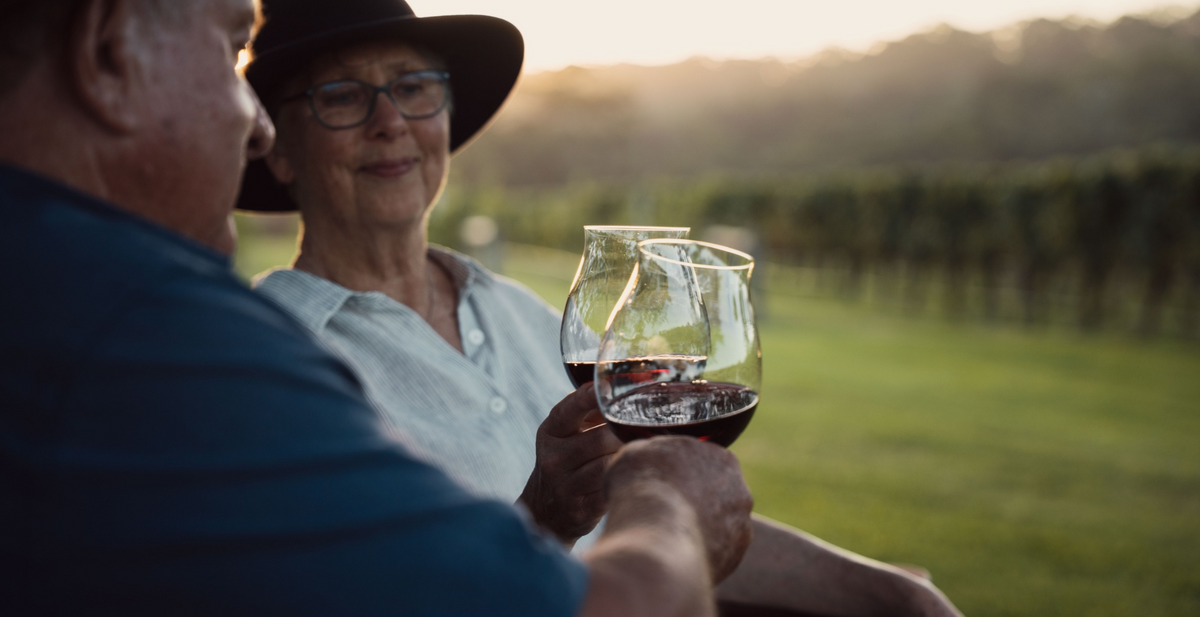
We meet over a glass of Singlefile Single Vineyard Mount Barker Pinot Noir at his gallery in Scotsdale, just a short distance from our Cellar Door. Turning onto Lantzke Road, I arrive at the striking studio building, where a collection of handcrafted ceramics, functional tableware and decorative pieces sits alongside large-scale acrylic landscape paintings.
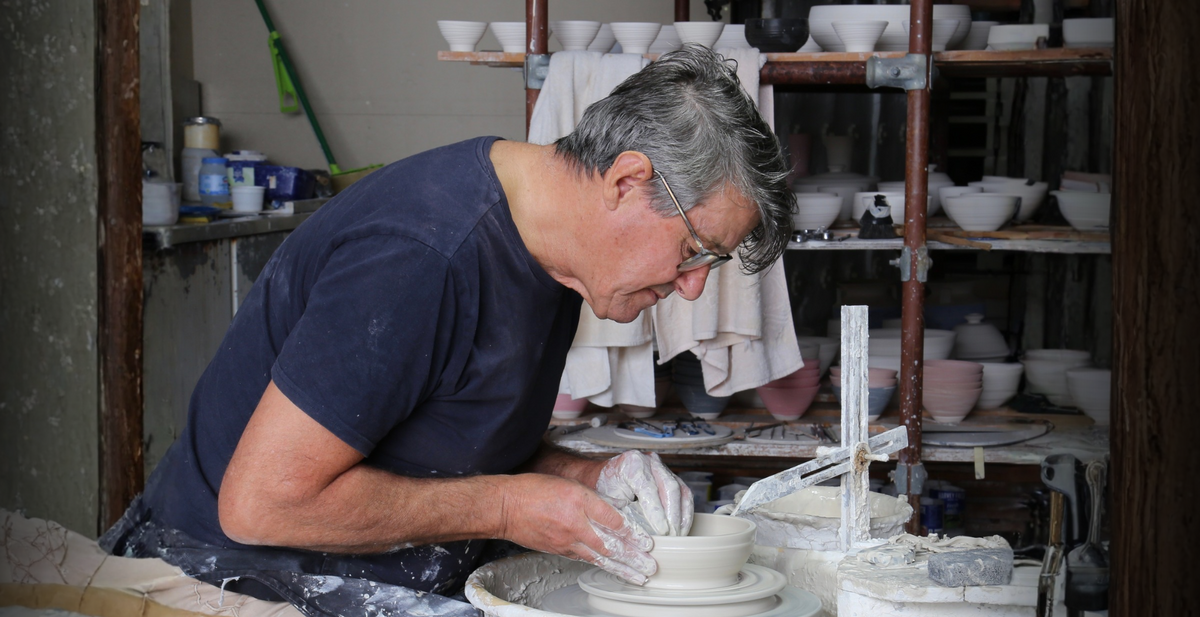
Adjoining the gallery, Jon’s workshop and studio reveal the evolution of his practice, alongside collections and commissioned pieces by his apprentice. In one corner, photographs and sketches trace the varied landscapes of the Great Southern, capturing the contours of the land, its waterways and the native flora that gives each area its own character.
The entire space is illuminated by a wall of glass looking towards Mount Lindesay, where the sweeping Scotsdale and Denmark valleys meet.
We make our way into the dining room, pour ourselves a glass of pinot noir and settle into conversation. The living space is a gallery in itself, filled with collected artworks, including pieces by his daughters, older brother and mother, and traditional textiles from different cultures which adorn the walls and are draped over everyday objects.

Finding His Way Back to the Great Southern
Jon’s journey to becoming an established ceramicist, whose work is now collected by three generations of customers, has its roots in the Great Southern. The youngest of five children, he spent much of his youth on a farm in Kendenup, near Mount Barker.
“My mother was into the arts, joining Plantagenet Potters and Painters back in the 1960s, a group which is still running today. I played around with the clay that she bought back, it was fun.”
After moving to Perth to complete his final years of high school, Jon made it only six months into Year 11 before leaving to pursue something he had found little encouragement for at school: the arts.
The following year, in 1972, Perth Technical College established a ceramics department on James Street. Jon enrolled in an Advanced Diploma of Ceramics, becoming one of only two teenage students in the course.
“I managed to complete the three-year course in two years, putting in 70 hours a week, so I could leave Perth and get back to the Great Southern. I’m a country boy.”
Jon settled in Denmark in 1975, establishing his own studio. It was a place that held particular meaning for him, having holidayed there as a child and where his parents had since settled, selling the family farm to run an orchard in Shadforth.
Between farm work and other odd jobs, Jon was determined to find a way to support himself entirely through his craft.
“Everyone teaches, very few people go and do it for themselves. That was my challenge: Can I make a living out of this?”
His early commissions were varied, from creating replicas of Chinese porcelain associated with the Batavia to crafting 800 clay pot chillums for Together Leather in Perth.
A Curiosity for Craft
With an abundance of timber from the region’s many mills, Jon developed a keen interest in wood-fired kilns. At the time, there was little knowledge locally of how to construct them or achieve the temperatures required for firing ceramics.
Around this time, alternative architect Wallace ‘Wally’ Greenham, whose work would leave a lasting impression on Denmark, began constructing an A-frame communal living space at The Cove, where Jon came to live. Alongside learning elements of the building trade from Wally, Jon constructed his first wood-fired kiln, using it to fire both his ceramics and, later, the bricks for his next kiln.
Having mastered the construction but still grappling with the intricacies of wood firing, Jon decided to travel to Japan, where these techniques had been refined over centuries. A stint working as a concreter, together with an exhibition in Fremantle at the Kidogo Arthouse alongside ceramic artist Joan Campbell, whose work explored the Japanese tradition of raku pottery, provided both the funds and inspiration for his journey.
“First, I went through Taipei to see the Chinese treasures that came out after the cultural revolution. I spent three whole days in the National Palace Museum, and barely covered a fraction of it.”
Continuing on to Japan, Jon was struck by the reverence afforded to ceramics, woodwork and carving, in contrast to his experience of the Western art world, where the emphasis at the time seemed to rest largely on the fine arts.
“I bought a little car and went to investigate woodfire kilns. I also took the opportunity to look at traditional artworks and fine craft. Stuff to push me and surprise me. I came back with no money and a rucksack full of clay.”
Returning to Denmark, Jon spent a short period creating fine art ceramics before turning his attention to wheel-thrown functional tableware, soon developing a commercial range.
In 1979, he met his late wife Vera in Albany on Christmas Eve, and they never looked back.
“We were married the next year and bought this place not long after that. We built the kiln, then the house,” he laughs.

The Discipline Behind the Art
With a mortgage and a young family, welcoming two children in 1983 and 1988, Jon developed a disciplined practice. At the time, he had some 1,200 gallery pieces in production, firing his large kiln every six weeks with between 300 and 400 pieces of tableware carefully stacked inside.
Kiln firings can be unpredictable, even for experienced ceramicists. In those early years, refining his firing and stacking techniques inevitably meant a number of pieces were lost to breakage. Today, Jon is reluctant to lose more than one per cent of his work in a firing and favours white clay for its strength and durability. Some of his customers, he tells me, have been using the same mugs for thirty years.
He retrieves a collection of vessels made many years ago from natural clay sourced near Bluff Knoll in the Stirling Range, reminding me that clay, too, is a finite resource. Today, he sources his clay from north of Melbourne.
Jon works primarily with stoneware, a medium he first fell in love with at the age of ten while visiting one of the biennial craft fairs that once travelled around the Great Southern. At the time, much of the pottery on display was earthenware, fired at lower temperatures and generally less durable than stoneware. It was the crystalline formations in the stoneware of an artist he remembers as Mrs Candy that first captured his imagination.
“She changed my whole perception, I often remembered it. When I started at college, it influenced my interest in stoneware.”
Another enduring influence on Jon’s work is minimalism, an appreciation that finds expression in the simplicity of his forms, the cleanness of his lines and his desire to distill things to their essential elements.
“I suppose it does come out of nature. Landforms, geology, geography. The shape of the land inspires me.”
The smallest things can provide this inspiration. He speaks of the individuality of gumnuts, no two quite alike, and the wildflowers that bloom along the wilderness trail at Ocean Beach each spring.
Over his decades as a ceramicist, Jon has witnessed considerable shifts in the fashions and habits that shape the tableware we use, changes that inevitably find their way into his production.
“Dinner plates are disappearing - everyone uses bowls. Or coupe plates, flat-bottomed with a rim on them, which I personally find undignified. They remind me of dog bowls.”

Interpreting the Landscape
As his career has progressed, Jon has found himself devoting more time to painting alongside his ceramic practice. He tells me humbly that he is not a “real artist”, before reeling off a list of artistic influences, many of which are entirely new to me.
“I work more in the abstract, I’m not a realist and never will be. I've always loved the abstract expressionists; artists like Jackson Pollock, Henri Matisse, Rothko. All are a huge influence.”
We are surrounded by large canvases and works in various stages of development. For Jon, painting is not simply about capturing a landscape, but expressing his own relationship with it. He shows me his Bluff Knoll series, an idea that has been years in the making and is now taking shape.
“I don’t want to tell you what it is. These pieces have names about specific places but that’s as much as I will say. They are expressions. Everyone sees something different in them, and that’s fascinating to me.”
Jon speaks of the conscious effort it takes to maintain uniqueness as an artist, to avoid inadvertently borrowing from the work of others, however inspiring he may find it. He believes originality emerges from continually challenging ourselves to explore new territory.
His years as an artisan have also taught him not to be too precious about his work, and to recognise the importance of looking critically at what we create.
“To be creative you must first be destructive, to re-create and to keep moving forward.”
There is something particularly rewarding about spending an afternoon with someone whose curiosity for their craft remains undiminished after decades of practice. In Jon’s work, there is a deep appreciation of place, a respect for his materials and a determination to keep refining what he does.
There is much in Jon’s approach that resonates with us at Singlefile, and it is part of what makes Denmark such a special place to call home. We feel fortunate to be among a community of artists, artisans and producers who continue to draw inspiration from this remarkable corner of the Great Southern, each expressing it in their own way.