A Glass with John Wade of Dark Side Chocolates
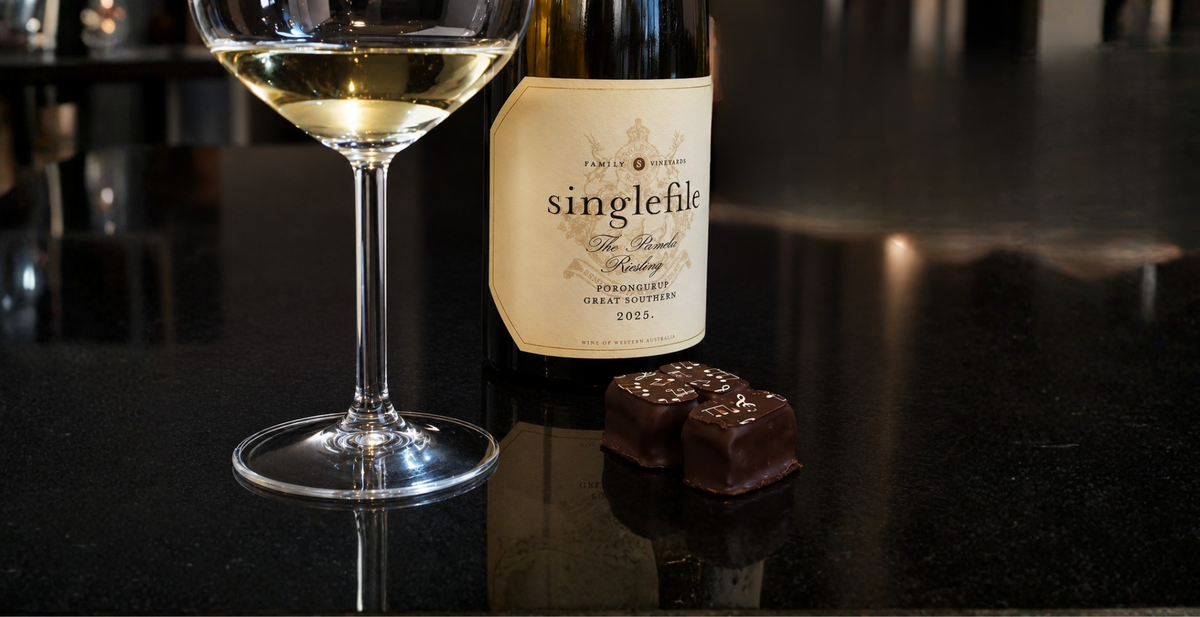
I am walking to meet John Wade, founder of Dark Side Chocolates in Denmark, Western Australia, with a bottle of 2025 ‘The Pamela’ Porongurup Riesling in hand, when I remember I’ve forgotten the wine glasses. But there is no need to worry. John is also a winemaker, with 52 vintages under his belt, and has us covered.
As I pour us both a glass on an overcast afternoon, surrounded by the sweet, rich smell of chocolate, we naturally begin talking about wine. Since 2008, John has been selling his fine, handcrafted chocolates out of Denmark, but his journey to chocolatier began with his winemaker’s palate.
From wine to chocolate in Denmark WA
John hails from ski country in Victoria and originally moved to the Great Southern in pursuit of making good wine - particularly riesling and cabernet sauvignon.
“If somebody had said to me before I came to the Great Southern that I would still be in Denmark in forty years’ time making chocolate and wine, I wouldn’t have believed them,” John tells me, incredulity written across his face.
After a chance encounter with a wine-appreciating accountant in his late twenties, John was introduced to good wine. Immediately hooked, he joined a wine club led by Ian Hickinbotham, or ‘Hicks’, who became influential in John’s decision to return to school to complete year twelve, before going on to enrol in and graduate from Winemaking School in Wagga Wagga, now Charles Sturt University.

“When I told my parents I was going back to school, I nearly had to pick Mum up off the floor,” he laughs.
He walked into his first job as assistant winemaker at Wynns Coonawarra in 1978 and, to his surprise, found himself head winemaker from that very first day; a role he would continue in for the following eight vintages.
John arrived in Denmark in 1986 as winemaker for both Goundrey and Alkoomi Wines. With part of his payment made in wine, a percentage went towards the creation of wines under the Howard Park and MadFish labels. It was while working for Russell and Linda at Rickety Gate Estate that John was tasked with sourcing chocolate to complement the wines, a project that would become the catalyst for an unexpected shift in his career.
A winemaker’s palate turned chocolatier
Explaining that his relationship with chocolate could previously be defined as: “See chocolate, eat chocolate,” John says this period of discovery soon grew into a genuine passion.
He attended a basic three-day introductory course at Savour Chocolate School in Melbourne, which he would quickly learn was the best in the Southern Hemisphere. In a room full of chefs, John’s winemaker’s palate stood out. Over the next six months, he went on to complete eight courses with Savour.
“The interest came out of nowhere, but the similarities between making wine and chocolate are striking. Before you make wine, you ferment the grapes. Before you make chocolate, you ferment the cacao. After that, it’s all about flavour, palate and structure. They are both highly technical processes.”
In 2008, the year after completing his courses at Savour, John opened Dark Side as Denmark’s first chocolatier.

Our chat is interrupted when John excuses himself to pull the curtain shut, protecting the delicate chocolate morsels from the afternoon sun spilling through the windows.
John tells me he finds his career genuinely good fun, and approaches it with the goal of producing something exceptional. The journey from cacao plant to the exquisitely decorated truffles sitting carefully in his shopfront is an extensive process, one he has come to know intimately over the last two decades.
The art of making chocolate
First, the cacao pod is split, revealing up to thirty beans, which are naturally fermented by their surrounding pulp. This fermentation imparts a distinct flavour that complements the beans’ regional character. Following fermentation, the beans are washed, roasted and crushed.
The processed cacao arrives to John as buttons, sourced from a Swiss company where he is able to select origin, roast level and strength from sustainable plantations around the world. Then comes the delicate task of tempering the chocolate, which involves heating, pouring it onto a black granite bench to cool and encourage crystal formation, before heating again and holding it at a stable 34°C - a careful combination of time, temperature and motion.
To John, chocolate is its own entity: a strong and powerful medium that can easily overpower, and therefore requires fine balance, especially when using raw native bush flavours such as native pepper, roasted wattleseed, strawberry gum and lemon myrtle.

He tastes every batch and, although he stops short of selecting a favourite, he does have his go-to truffles depending on his mood. For a more savoury flavour, John reaches for Beetroot Shiraz. When craving something sweeter, he selects the Jelly Sandwich: a raspberry jelly centre sandwiched between passionfruit white chocolate and blood orange milk chocolate, encased in a dark chocolate shell.
“Honestly, it can be hard to go past the classic ganache truffle. It’s just chocolate. No other flavours are necessary,” he tells me, as he passes me one to try. He’s right.
And for a truffle to savour alongside our riesling, John suggests lemon myrtle, again proving his palate.
How to taste chocolate properly
The maker usually knows the best way to enjoy their product, and so I tune in when John explains how best to experience chocolate.
“The melting point for chocolate is 36 degrees, and your blood temperature is around 35. The best way to eat chocolate is to place it in your mouth and slowly let it dissolve. It takes longer, but you get the full flavour and the best texture. The moment you start chewing, you lose the texture.”
John is content working with the glorious medium of cacao. His satisfaction as an artisan, like many others, exists not only in the dedicated and delicate art of creating, but also in witnessing the enjoyment of his customers and friends - both new and returning.